
TDD Double Loop
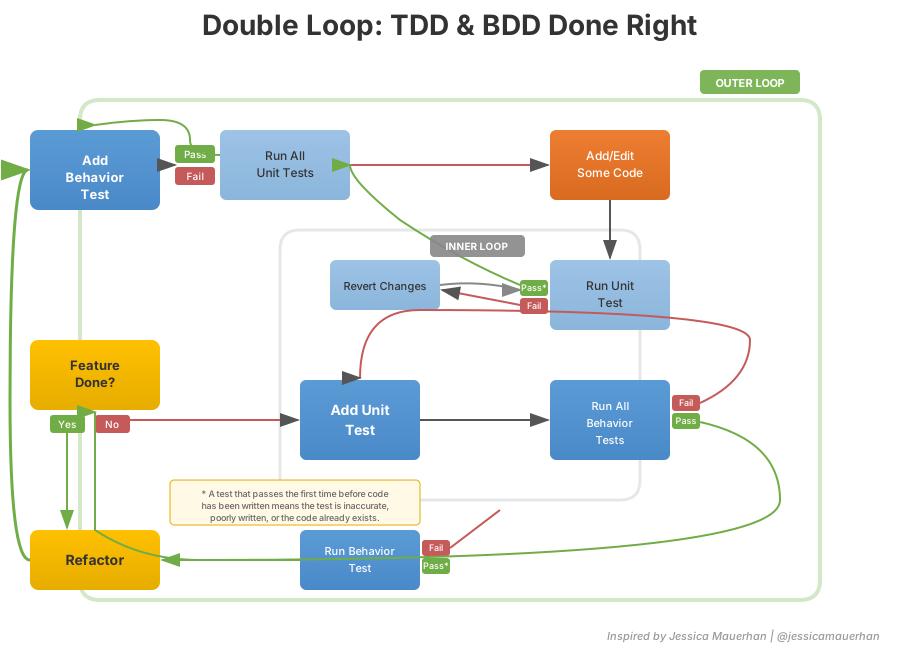
The TDD Double Loop is a powerful development methodology that combines Behavior-Driven Development (BDD) with traditional Test-Driven Development (TDD). It creates two nested feedback loops that guide you from user requirements to working code.
What is the Double Loop?
The Double Loop consists of two feedback cycles operating at different timescales:
| Loop | Timescale | Focus | Tools |
|---|---|---|---|
| Outer Loop (BDD) | Hours to Days | User behavior, business requirements | Pest BDD, Cucumber, Behat |
| Inner Loop (TDD) | Minutes | Implementation details, code design | Pest, PHPUnit |
The Core Idea
Start from the outside, work inward.
- Write a failing behavior test (BDD) that describes what the user wants
- Write failing unit tests (TDD) to build the components needed
- Make unit tests pass with minimal code
- Watch the behavior test pass
- Refactor with confidence
┌─────────────────────────────────────────────────────────────┐
│                      OUTER LOOP (BDD)                       │
│                                                             │
│   Feature: User Registration                                │
│     Scenario: User registers successfully                   │
│       Given I am on registration page                       │
│       When I submit valid credentials         ◄── FAILING   │
│       Then I should have an account                         │
│                                                             │
│   ┌─────────────────────────────────────────────────────┐   │
│   │                  INNER LOOP (TDD)                   │   │
│   │                                                     │   │
│   │   test('creates user with hashed password')         │   │
│   │   test('sends welcome email')                       │   │
│   │   test('logs user in')                              │   │
│   │                                                     │   │
│   │   RED → GREEN → REFACTOR → RED → GREEN → ...        │   │
│   │                                                     │   │
│   └─────────────────────────────────────────────────────┘   │
│                                                             │
│   ✓ Scenario: User registers successfully     ◄── PASSING   │
│                                                             │
└─────────────────────────────────────────────────────────────┘
Why Use the Double Loop?
1. Outside-In Development
You start with what users need and work inward to implementation:
User Need → Feature → Steps → Service → Model → DatabaseThis ensures you never build features nobody asked for.
2. Two Levels of Confidence
| Level | What It Tests | What It Catches |
|---|---|---|
| Behavior Tests | Business requirements | Missing features, wrong behavior |
| Unit Tests | Implementation details | Bugs, edge cases, regressions |
3. Living Documentation
Feature files serve as always-accurate, executable documentation:
# This IS the specification - and it runs!
Feature: Shopping Cart
  Scenario: Add item to cart
    Given I have an empty cart
    When I add "iPhone 15" to the cart
    Then my cart should contain 1 item
4. Refactoring Safety
Change implementation freely - if behavior tests pass, user experience is preserved:
# Refactor internals completely
# As long as this passes, users are happy:
pest --bdd
# ✓ User can register
# ✓ User can add items to cart
# ✓ User can checkout
The Critical Rule
Test Must Fail First
A test that passes the first time (before code is written) means one of:
- The test is inaccurate or poorly written
- The test is not added to the test suite
- The code/feature already exists
If a new test passes immediately, investigate why!
When to Use Each Loop
Use the Outer Loop (BDD) for:
- New features
- User-facing behavior
- Business requirements
- Integration scenarios
- Acceptance criteria
Use the Inner Loop (TDD) for:
- Implementation details
- Edge cases
- Error handling
- Performance optimization
- Internal APIs
Double Loop vs Classic TDD vs Traditional Testing
| Aspect | Traditional | Classic TDD | Double Loop |
|---|---|---|---|
| Test writing | After code | Before code | Before code |
| Starting point | Implementation | Unit/Class | User requirement |
| Direction | Inside-out | Inside-out | Outside-in |
| Test scope | Often mixed | Unit focused | Clearly separated (BDD + TDD) |
| Business visibility | Low | Low | High (Gherkin readable) |
| Documentation | Separate from tests | Tests as docs (technical) | Tests ARE documentation (business) |
| Refactoring | Risky | Safe (unit level) | Safe (behavior + unit level) |
| Feedback loop | None | Single (RED-GREEN-REFACTOR) | Double (BDD → TDD → BDD) |
| Stakeholder involvement | After development | Rarely | From the start |
Section Contents
This section covers:
- The Workflow - Step-by-step guide to the Double Loop process
- TDD Schools - London vs Chicago approaches
- Tutorial - Complete hands-on example
Further Reading
- Growing Object-Oriented Software, Guided by Tests - Freeman & Pryce
- Double Loop: TDD & BDD Done Right - Jessica Mauerhan
- Samman Coaching - Double Loop TDD